What Is DNS? Explained Simply (No Technical Confusion)
Every day, we type website names like google.com, youtube.com, or amazon.in into our browser.
Within seconds, the website opens.
But have you ever wondered:
How does the internet know where that website is located?
This is where DNS comes in.
DNS works quietly in the background, but without it, the internet as we know it would be almost impossible to use.
Let’s understand DNS in the simplest way.
What Is DNS? (Simple Definition)
DNS stands for Domain Name System.
In very simple words:
👉 DNS is the phonebook of the internet.
Hum humans website names yaad rakhte hain.
Computers numbers samajhte hain.
DNS ka kaam hai:
- Website name ko
- Uske IP address (numbers) me badalna
Why Do We Even Need DNS?
Computers don’t understand names like google.com.
They only understand numbers, such as:
142.250.190.14
Imagine if you had to remember numbers like this for every website.
It would be impossible.
DNS solves this problem by acting as a translator between:
- Human language (website names)
- Computer language (IP addresses)
Real-Life Example to Understand DNS
Think of your mobile phone.
You save a contact as “Mom”.
But internally, your phone uses a number.
When you tap “Mom”:
- Phone looks up the number
- Then makes the call
DNS works the same way:
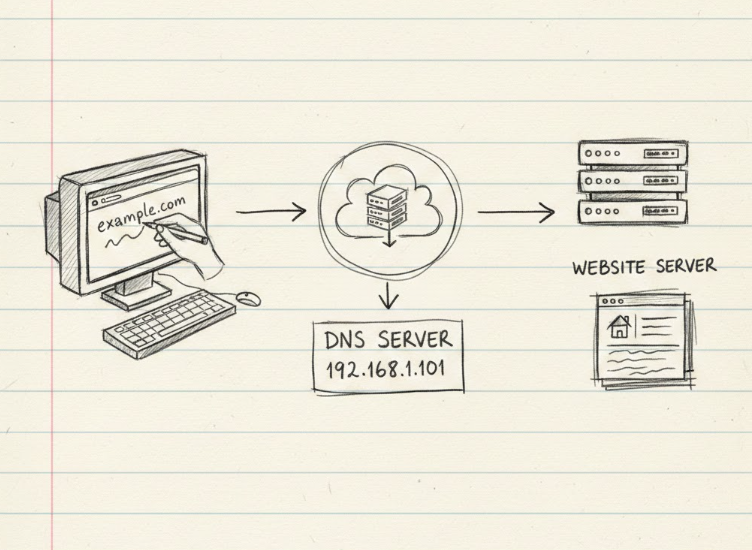
- You type
example.com - DNS finds the IP address
- Browser connects to the server
Simple.
How DNS Works (Step by Step)
Let’s see what happens when you type a website URL.
Step 1: You Type the Website Name
You enter www.example.com in your browser.
Step 2: Browser Asks DNS
The browser asks:
“What is the IP address of this website?”
Step 3: DNS Looks for the Answer
DNS checks:
- Local cache
- Internet service provider (ISP)
- Other DNS servers if needed
Step 4: DNS Returns the IP Address
DNS replies with something like:
93.184.216.34
Step 5: Browser Connects to the Server
Now the browser knows where the website is and loads it.
All this happens in milliseconds.
What Is an IP Address?
An IP address is a unique number given to every server on the internet.
You can think of it as:
- A house address
- That tells where the website lives
DNS simply helps you find that address easily.
Why Sometimes Websites Don’t Open (DNS Issues)
Sometimes you see errors like:
- “DNS not responding”
- “Website not found”
This can happen if:
- DNS server is slow
- Internet connection has issues
- Website server is down
That’s why changing DNS (like using public DNS) sometimes fixes problems.
Is DNS Important for Security?
Yes, very important.
DNS also helps with:
- Blocking fake websites
- Protecting against malicious domains
- Faster and safer browsing
That’s why secure DNS services are widely used today.
Why Developers and Tech Learners Should Understand DNS
If you are learning:
- Web development
- Backend
- DevOps
- Cloud computing
Then DNS is a basic foundation.
Understanding DNS helps you:
- Debug website issues
- Understand server connections
- Learn how the internet actually works
DNS in Simple Words (One Line)
👉 DNS helps your browser find the correct website by translating names into numbers.
That’s it.
Final Thoughts
DNS is one of the most important but invisible parts of the internet.
You may never see it working,
but every website you open depends on it.
Without DNS:
- Internet would be slow
- Websites would be hard to access
- User experience would be terrible
DNS keeps the internet simple for humans and efficient for machines.