What Is a Reverse Proxy? Explained With Real Use Cases
If you’ve ever used Nginx, Apache, Cloudflare, or AWS Load Balancer, you’ve indirectly used a reverse proxy, even if you didn’t know it.
The problem is, most explanations make it sound complicated. So let’s break it down in simple terms, with relatable examples and modern use cases.
🧱 What Is a Reverse Proxy? (Simple Explanation)
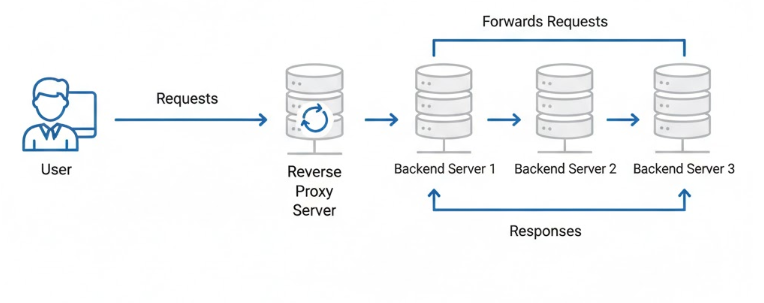
A reverse proxy is a server that sits between the internet and your backend servers.
It works like a security guard at the gate:
-
People come to the guard (reverse proxy)
-
The guard talks to the internal departments (backend servers)
-
The guard returns the response back to the visitor
So users never talk directly to your backend servers.
🏠 Normal Request vs Reverse Proxy Request
🔹 Without Reverse Proxy (Direct):
User → Backend Server
🔹 With Reverse Proxy:
User → Reverse Proxy → Backend Server
This extra layer provides control, speed, security, logging, caching, routing — everything.
👤 Forward Proxy vs Reverse Proxy (Simple Difference)
Most beginners get confused between forward proxy and reverse proxy.
Here’s the easiest explanation:
✔ Forward Proxy → Protects the client
-
Example: VPN, corporate proxy
✔ Reverse Proxy → Protects the server
-
Example: Nginx in front of backend
So:
🛡 Forward Proxy = User privacy
🛡 Reverse Proxy = Server protection
💡 Real-Life Analogy (Easy to Remember)
Imagine a company office:
-
Visitors are customers (internet users)
-
Receptionist is the reverse proxy
-
Employees in rooms are backend servers
Customer never directly talks to employees — they talk to the receptionist.
Similarly, users never directly connect to backend servers — they go through the reverse proxy.
🧰 Popular Reverse Proxy Tools (Used in 2026)
Some widely used reverse proxies today:
-
Nginx
-
Apache
-
HAProxy
-
Envoy
-
Traefik
-
Cloudflare (edge reverse proxy)
-
AWS ALB / ELB
-
Kubernetes Ingress Controller
If you're deploying modern apps, you’ll hit one of these for sure.
📦 What Does a Reverse Proxy Actually Do?
Here are the major features:
1. Load Balancing
Distributes traffic across multiple servers.
Example:
-
10,000 users hit your website
-
Reverse proxy splits load across 3 backend servers
✨ Result: No downtime during traffic spikes
2. Security & Protection
Reverse proxy hides your internal servers.
Benefits:
✔ Real IP of servers not exposed
✔ Attack surface reduced
✔ DDoS protection possible
✔ TLS termination at proxy
This is why Cloudflare is used massively.
3. SSL/TLS Termination
Reverse proxy can handle HTTPS encryption, so backend can run simple HTTP.
Example:
-
Nginx handles SSL
-
Django/Laravel run HTTP internally
Reduces backend CPU load.
4. Routing & API Gateway
Reverse proxy routes requests to different apps based on path or domain.
Example:
Perfect for microservices.
5. Caching
Reverse proxy can store static responses to reduce backend load.
Example:
-
Images
-
HTML pages
-
CSS/JS
-
API responses
Cloudflare does page caching globally.
6. Compression & Optimization
Compress files like CSS/JS/JSON using gzip or brotli to speed up delivery.
🌍 Real Use Cases (With Simple Examples)
Now the fun part — where is reverse proxy actually used?
📌 Use Case 1: High Traffic Websites
If Flipkart, Amazon, Zomato, Swiggy directly exposed backend servers, they would crash daily.
Reverse proxy helps by:
✔ load balancing
✔ caching
✔ routing
✔ rate limiting
📌 Use Case 2: Microservices Routing
Modern apps are not monoliths.
Example routing:
Reverse proxy = API gateway entry point.
📌 Use Case 3: Kubernetes Ingress
In Kubernetes, Ingress Controller is basically a reverse proxy that:
-
Routes traffic
-
Applies SSL
-
Handles domains
Examples: Nginx, Traefik, HAProxy
📌 Use Case 4: Cloudflare Edge Proxy
Cloudflare sits between user and backend.
Benefits:
✔ DDoS protection
✔ Caching
✔ SSL
✔ Firewall
Millions of websites use it now.
📌 Use Case 5: Hiding Private Services
Banks, fintech, healthcare apps hide backend servers to prevent attacks.
Reverse proxy prevents:
❌ Direct database exposure
❌ Direct API exposure
❌ IP leaks
🧪 Quick Example (How Nginx Reverse Proxy Works)
User requests:
Nginx config sends it to:
User never knows Flask is running inside.
🧩 Why Reverse Proxy Matters in 2026
Modern stack consists of:
-
Containers
-
Microservices
-
Kubernetes
-
Cloud infra
-
CI/CD
-
Zero Trust architectures
Reverse proxy is a critical entry point in all these.
Without it, web apps would be:
❌ Slower
❌ Less secure
❌ Hard to scale
📝 Conclusion
A reverse proxy is a smart middle layer that:
✔ Protects servers
✔ Speeds up websites
✔ Handles load
✔ Manages SSL
✔ Routes microservices
If you're learning backend, DevOps, or cloud in 2026, understanding reverse proxies is mandatory — not optional.