#️⃣ SQL vs NoSQL Databases: What Should You Choose in 2026?
When you start building applications (web, mobile, AI tools, dashboards, etc.), one of the biggest decisions is choosing the right database. By 2026, the choice has become even more interesting because data is bigger, faster, and more complex than ever before.
Still, one common question remains:
👉 Should you choose SQL or NoSQL?
The truth is — there is no universal winner.
The right choice depends on your data, use case, and scaling needs.
Let’s understand both properly — not in a boring textbook way, but like how real developers think.
🟦 What Exactly Is SQL? (Relational Databases)
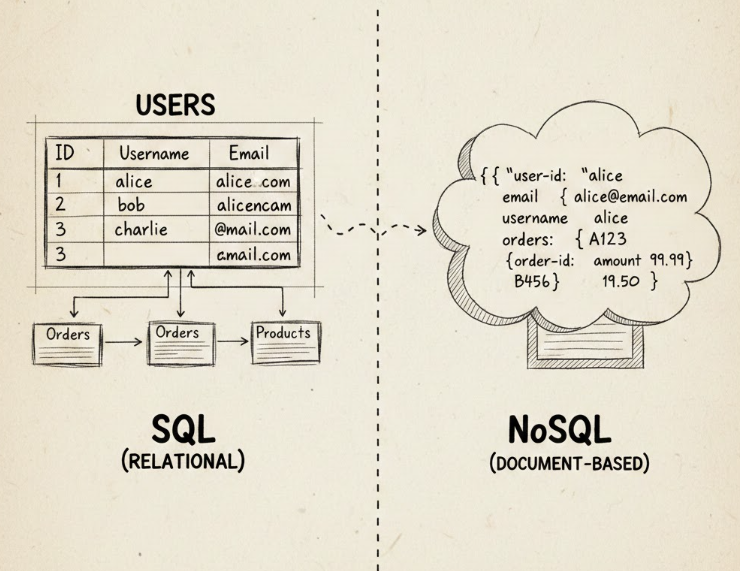
SQL databases store data in tables with rows and columns, just like spreadsheets.
And most importantly:
✔ Every row follows the same structure
✔ Data relationships are strong and meaningful
✔ Queries follow SQL language (SELECT, INSERT, JOIN…)
Examples of SQL databases:
-
MySQL
-
PostgreSQL
-
MariaDB
-
SQL Server
-
Oracle
Where SQL shines:
SQL databases are perfect for situations where:
✔ Data must be accurate
✔ Data must follow rules
✔ Relationships matter
✔ Consistency is priority
For example:
-
Banking transactions
-
E-commerce product inventory
-
Healthcare patient records
-
Airline ticket booking
-
Accounting and finance
Imagine a bank account:
If you transfer ₹1000,
you don’t want the database to “eventually” update it.
You want it immediately, accurately and reliably —
That’s where SQL wins.
🟩 What Exactly Is NoSQL? (Non-Relational Databases)
NoSQL databases do not use fixed tables.
Data can be stored in different flexible shapes like:
✔ Documents
✔ Key-Value pairs
✔ Wide Columns
✔ Graphs
Popular NoSQL databases:
-
MongoDB (Document)
-
Redis (Key-Value)
-
Cassandra (Wide-Column)
-
Neo4j (Graph)
-
Firebase / DynamoDB (Document + Key-Value)
Where NoSQL shines:
NoSQL is ideal when:
✔ Data structure changes frequently
✔ Huge scaling is required
✔ Low latency is needed
✔ Relationships don't matter much
For example:
-
User activity logs
-
Sensor data and IoT
-
Messaging apps
-
Leaderboards
-
Social media feeds
-
Real-time analytics
If you are building the next Instagram or Twitter,
NoSQL makes your life easier.
⚔️ SQL vs NoSQL — Real Differences That Actually Matter
Let’s break it down in a practical way developers understand:
| Feature | SQL | NoSQL |
|---|---|---|
| Data Model | Structured | Flexible |
| Schema | Fixed | Schema-less |
| Scaling | Vertical | Horizontal |
| Consistency | Strong | Eventual (mostly) |
| Speed | Slower for large writes | Faster writes |
| Querying | Powerful (joins) | Simple queries |
| Use Case | Transactions | Real-time big data |
Quick explanation:
-
Vertical scaling = Bigger server (more CPU, RAM)
-
Horizontal scaling = More servers (distributed)
By 2026, most modern apps prefer horizontal scaling,
which is why NoSQL became popular.
🏦 When SQL Is the Better Choice (2026 Perspective)
Choose SQL if your app requires:
✔ Strong consistency
✔ Complex JOINs
✔ Reliable ACID transactions
✔ Structured, stable data
Typical examples:
✔ Banking & payments
✔ Enterprise software
✔ HR & Payroll systems
✔ ERP & Inventory systems
✔ Medical records
✔ School/College systems
If your business deals with money or records, SQL is your friend.
🌍 When NoSQL Is the Better Choice (2026 Perspective)
Choose NoSQL if your app needs:
✔ Massive scale
✔ Low-latency writes
✔ Flexible and fast changing data
✔ Real-time analytics
Typical examples:
✔ Social networks (feeds, likes, comments)
✔ Chat systems & messaging
✔ IoT sensor logs
✔ Personalization engines
✔ Leaderboards (gaming)
✔ Recommender systems
If your app collects millions of small data points per second, NoSQL wins.
🧠 Important Point: Many Modern Systems Use Both
It’s not always SQL vs NoSQL.
Often it’s SQL and NoSQL.
For example:
-
E-commerce app:
-
Orders & payments → SQL
-
Browsing history & recommendations → NoSQL
-
-
Ride-sharing app:
-
Driver earnings → SQL
-
Real-time location → NoSQL
-
This hybrid approach is becoming common in 2026.
🧩 Popular Companies: What They Use
| Company | SQL | NoSQL |
|---|---|---|
| Amazon | PostgreSQL | DynamoDB |
| Netflix | MySQL | Cassandra |
| Uber | PostgreSQL | Redis + Cassandra |
| Meta (Facebook) | MySQL | Cassandra + RocksDB |
| YouTube | MySQL | Bigtable |
Notice something?
👉 Nobody relies on just one.
📌 Which One Should You Choose in 2026?
Here’s a simple rule:
✔ Choose SQL if:
-
Data is structured
-
Relationships matter
-
Accuracy > speed
-
Schema rarely changes
✔ Choose NoSQL if:
-
Data is unstructured
-
Scaling is priority
-
Speed > accuracy (short-term)
-
Schema changes frequently
🏁 Conclusion
SQL vs NoSQL is not about "better" or "worse".
Both have different strengths.
-
SQL = stability, structure, correctness
-
NoSQL = speed, flexibility, scale
The smartest developers in 2026 know when to combine both.
If your application needs strong transactional reliability → go SQL.
If it needs massive real-time data handling → go NoSQL.
Right database = smoother app + happier users + fewer headaches.