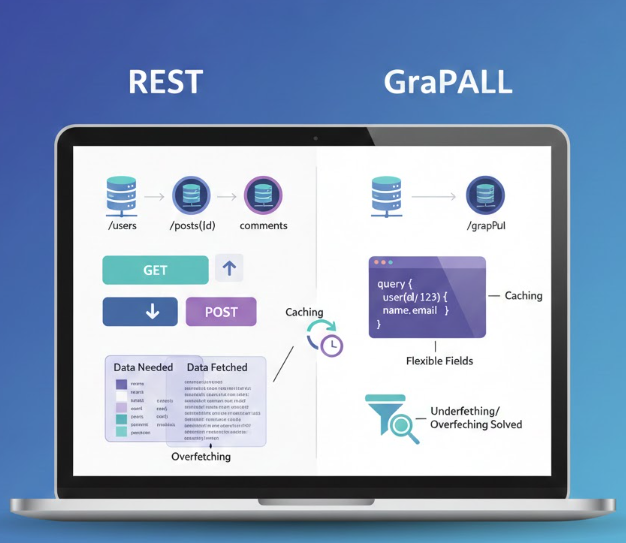
REST vs GraphQL: Which API Style Fits Modern Development?
Modern applications run on APIs. Whether it’s a mobile app fetching user profiles, a frontend dashboard loading analytics, or a backend service talking to another service — everything moves through APIs. For more than a decade, REST has been the default style for building APIs. But in recent years, GraphQL has entered the scene and changed how clients ask for data.
Both REST and GraphQL solve the same problem — data communication between client and server — but they do it in very different ways. And understanding those differences helps developers choose the right tool for the right job.
What is REST?
REST (Representational State Transfer) is a set of architectural principles designed around resources. Each resource is exposed through an endpoint, and data is transferred usually in JSON format.
Example REST endpoints:
-
GET /users -
GET /users/12 -
POST /users -
GET /users/12/posts
REST heavily relies on HTTP verbs (GET, POST, PUT, DELETE) to describe actions.
Key Characteristics
-
Resource-based endpoints
-
Multiple endpoints to fetch related data
-
Cache-friendly via HTTP caching
-
Mature ecosystem & tooling
REST is simple and predictable, which is why most APIs in production today still use it.
What is GraphQL?
GraphQL is a query language for APIs originally built by Facebook. Instead of hitting fixed endpoints, the client sends a single query that specifies exactly what fields it wants.
Example GraphQL query:
GraphQL returns JSON with only the requested fields — nothing less, nothing more.
Key Characteristics
-
Single endpoint (
/graphql) -
Client controls the shape of data
-
Strong typing system (schema)
-
Built-in introspection & documentation
GraphQL gives more power to the client and reduces back-and-forth requests.
The Data Fetching Problem
GraphQL mainly became popular due to two common REST problems:
1. Overfetching
Client receives more data than needed.
Example REST endpoint returns full user object even if client only needs username.
2. Underfetching
Client receives less data than needed, forcing multiple calls.
Example:
-
Request 1:
/users/10 -
Request 2:
/users/10/posts -
Request 3:
/users/10/friends
GraphQL solves both by allowing nested structured queries in a single call.
Performance Considerations
REST Performance
REST performs well when:
-
Data sets are fixed
-
Caching matters
-
CDN usage is important
CDNs cache REST responses easily:
-
Static pages
-
Product catalogs
-
Public resources
GraphQL Performance
GraphQL reduces network traffic for mobile/slow connections because:
-
Client fetches only required fields
-
Single request reduces latency overhead
However, caching is more complex because responses vary based on queries.
GraphQL is powerful for:
-
Mobile apps
-
Frontend dashboards
-
Complex relational data
Tooling & Ecosystem
REST Ecosystem
REST has been around longer, so:
-
Libraries are stable
-
Tools are mature
-
Debugging is easier
-
CDN caching works seamlessly
Popular tools:
-
Postman
-
Swagger / OpenAPI
-
Insomnia
GraphQL Ecosystem
GraphQL is newer but growing fast:
-
Built-in documentation through schema
-
Type safety benefits
-
Autocomplete in IDEs
Popular tools:
-
Apollo Client / Server
-
GraphQL Playground
-
Hasura
-
Yoga
Typing & Schema
GraphQL Has Strong Typing
GraphQL uses a schema to define:
-
Types
-
Fields
-
Relations
Example:
Clients know exactly what data exists.
REST Schema Isn’t Standardized
REST JSON responses can vary; documentation relies on OpenAPI/Swagger. Developers must maintain docs separately.
Error Handling
REST Errors
REST uses HTTP status codes:
-
200 OK
-
201 Created
-
400 Bad Request
-
404 Not Found
-
500 Server Error
Easy for debugging and logs.
GraphQL Errors
GraphQL returns errors in response body, not via HTTP codes. Good for partial successes but harder for logging.
Security Considerations
REST can restrict access using:
-
Rate limiting per endpoint
-
Role-based routes
-
HTTP method permissions
GraphQL needs extra care for:
-
Query complexity limits
-
Depth limiting
-
Introspection restrictions
Because clients can craft huge nested queries that overload backend servers.
When REST Makes More Sense
Choose REST if:
✔ Public APIs with CDN caching
✔ Simple resource-based data
✔ Predictable endpoints
✔ Strong HTTP semantics needed
✔ Logging & monitoring matters
✔ Highly scalable microservices
Example usage:
-
E-commerce product APIs
-
Payment gateways
-
Authentication services
-
IoT device communication
When GraphQL Makes More Sense
Choose GraphQL if:
✔ The client needs flexible querying
✔ Mobile devices are primary consumers
✔ Nested relational data is common
✔ Bandwidth is limited
✔ Frontends change frequently
✔ Single endpoint simplifies architecture
Example usage:
-
Social media feeds
-
Real-time dashboards
-
Analytics frontends
-
Mobile apps with custom UI
Real World Adoption
Companies Using GraphQL
-
Facebook
-
GitHub (v4 API)
-
Shopify
-
Netflix
-
Pinterest
Companies Using REST
-
PayPal
-
Stripe
-
Twitter
-
AWS Services
-
Most public web APIs
Important note: Many companies use both depending on use case.
Final Verdict
There is no universal winner — context decides.
-
If you need simple, cacheable, stable APIs → Use REST
-
If you need flexible, client-driven, relational querying → Use GraphQL
In other words:
REST is great for standardized data delivery.
GraphQL is great for customized data consumption.
Modern backend architectures often combine both:
-
REST for core services
-
GraphQL as a data gateway for frontends
That’s how modern development balances flexibility with performance.