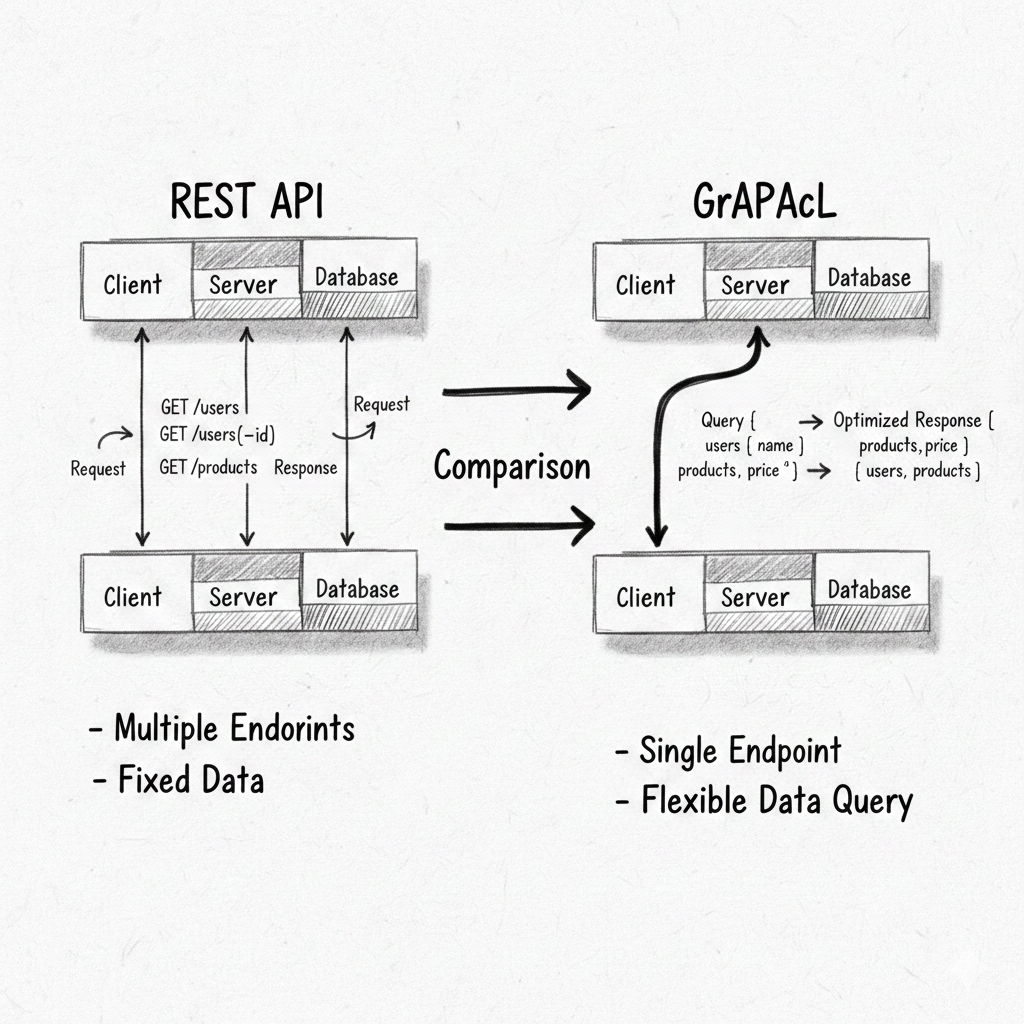
REST API vs GraphQL: Which One Should You Use in 2026?
In modern web and app development, APIs are the backbone of everything.
From mobile apps and websites to AI tools and SaaS platforms, APIs decide performance, scalability, and developer experience.
For years, REST API has been the default choice.
But in recent times, GraphQL has gained massive popularity.
So the big question for developers in 2026 is:
👉 Should you stick with REST API or move to GraphQL?
Let’s break this down in a simple, honest, real-world way.
🔹 What Is a REST API? (Quick Recap)
REST (Representational State Transfer) is an API architecture where:
- Each URL represents a resource
- Different HTTP methods do different actions
Example:
GET /users→ get all usersGET /users/5→ get user with ID 5POST /users→ create a user
✅ Why REST Became Popular
- Simple and predictable
- Easy to understand for beginners
- Supported everywhere (browsers, mobile, servers)
REST APIs are still widely used in banks, government apps, e-commerce, and enterprise systems.
🔹 What Is GraphQL? (Simple Explanation)
GraphQL is a query-based API language where the client decides:
- What data it needs
- How much data it needs
Instead of multiple endpoints, GraphQL usually has one endpoint.
Example (Simple):
Client asks:
“Give me user name and email only.”
Server responds with exactly that, nothing extra.
🧠 Core Difference (In One Line)
- REST: Server decides what data to send
- GraphQL: Client decides what data to receive
This single difference changes everything.
⚖️ REST API vs GraphQL – Key Differences
🔹 REST API
- Multiple endpoints
- Fixed data response
- Simple caching
- Easy to debug
- Best for standard CRUD apps
🔹 GraphQL
- Single endpoint
- Flexible data fetching
- Avoids over-fetching & under-fetching
- Slightly complex to learn
- Best for complex frontends
📱 Real-Life Example
Scenario: Food Delivery App
Using REST API 🍔
To show restaurant page, app may call:
/restaurant/menu/reviews/offers
➡️ Multiple API calls = more network usage
Using GraphQL 🍕
One request:
“Give me restaurant name, menu items, and offers”
➡️ One call = faster experience
That’s why modern apps prefer GraphQL for frontend-heavy products.
🚀 Performance Comparison
REST API Performance
- Good for simple apps
- Faster to set up
- Works great with caching (CDN)
GraphQL Performance
- Reduces unnecessary data transfer
- Better for mobile apps
- Can be heavy on server if badly designed
👉 Performance depends more on implementation, not just technology.
👨💻 Developer Experience
REST API
- Easy for beginners
- Large community
- Tons of tutorials
GraphQL
- Strong typing system
- Auto documentation
- Better frontend-backend coordination
Frontend developers especially love GraphQL.
🔐 Security Considerations
- REST uses standard auth (JWT, OAuth)
- GraphQL also supports secure auth
- GraphQL needs query limits to prevent abuse
Security is not a weakness of either —
bad coding is.
🏢 When Should You Use REST API in 2026?
Use REST if:
- You’re building simple CRUD apps
- You want fast development
- Your team is beginner-heavy
- You need strong caching
Examples:
- Admin panels
- Blogs
- Small business websites
- Government or enterprise systems
🤖 When Should You Use GraphQL in 2026?
Use GraphQL if:
- Frontend is complex
- Multiple clients (web + mobile)
- Performance matters a lot
- You want flexible data fetching
Examples:
- Social media apps
- SaaS dashboards
- Mobile-first products
- AI-powered platforms
💡 Final Verdict (Honest Answer)
There is no universal winner.
👉 REST API is still powerful and relevant in 2026.
👉 GraphQL is the future for complex, data-heavy applications.
Best Strategy:
- Learn REST first
- Then move to GraphQL
Most real companies use both, depending on use case.