Monolithic vs Microservices Architecture: What’s Better in 2026?
When people talk about modern backend development, one comparison always comes up: Monolithic vs Microservices.
If you’re building an app in 2026—whether it’s an e-commerce store, a SaaS platform, or a mobile app—you'll eventually need to decide which architecture to use. And that decision affects everything: build time, scaling, hiring, hosting, bugs, deployment, and cost.
So let’s break things down in a simple, real-world way, without complicated jargon.
🧱 What is a Monolithic Architecture? (Simple Explanation)
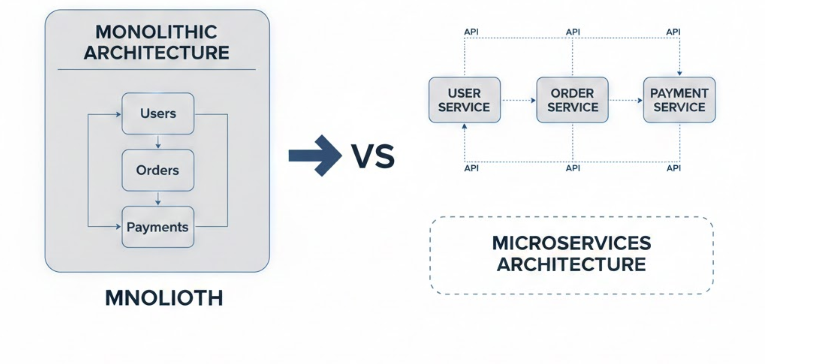
A monolithic app is like one big building where everything happens inside a single structure.
Imagine a restaurant:
-
Kitchen inside
-
Billing inside
-
Delivery inside
-
Storage inside
Everything is in one place.
In software, a monolith means:
✔ Single codebase
✔ Single database
✔ Single deployment
Example stack:
-
Django + PostgreSQL deployed as one app
-
Laravel + MySQL in one server
-
Spring Boot + Oracle in one war file
Pros of Monolithic
👍 Simple to develop (at the beginning)
👍 Easy to debug locally
👍 Single deployment = less DevOps complexity
👍 Great for small teams & MVPs
Cons of Monolithic
👎 Scaling becomes hard as app grows
👎 If one part breaks, whole app suffers
👎 Slower development for large teams
👎 Tech stack lock-in (hard to mix languages)
🕸️ What Are Microservices? (Simple Explanation)
Microservices are like a shopping mall:
Every shop works independently—billing, food, clothes, etc.
In microservices:
✔ The app is broken into independent services
✔ Each service has its own codebase
✔ Each service can have its own database
✔ Each service is deployed and scaled separately
Example:
-
User Service
-
Order Service
-
Payment Service
-
Notification Service
Even technology can differ:
-
Payment service → Go
-
Notification service → Node.js
-
User service → Python
Pros of Microservices
👍 Scale only what’s needed (ex: only payment during sale)
👍 Team independence (Backend teams don’t step on each other)
👍 Tech flexibility (Use the right language for the job)
👍 Fault isolation (If email breaks, checkout still works)
👍 Faster deployments with CI/CD
Cons of Microservices
👎 Complex DevOps (Docker + Kubernetes + API gateways)
👎 More network communication = more failure points
👎 Monitoring & debugging become harder
👎 Costs increase (infra + networking + logging)
🏢 Real Life Examples (Easy to Understand)
👉 Monolithic Example
A small bakery with:
-
One shop
-
One chef
-
One counter
Easy for small scale.
👉 Microservices Example
Swiggy / Amazon
-
Ordering
-
Payment
-
Delivery tracking
-
Restaurant menu
All independent systems talking through APIs.
🚀 Which One Is Better in 2026? (Honest Answer)
There is no universal “best”—it depends on your phase.
Let’s break down by use-case.
🧩 Best for Startups & Small Teams
If you’re building:
✔ MVP
✔ Small e-commerce
✔ SaaS prototype
✔ Client project
Then Monolithic wins, because:
-
Faster to build
-
Cheaper hosting
-
Easier to maintain
-
Less DevOps headache
Example setup in 2026:
-
Django + Postgres on Render
-
Laravel + MySQL on Hostinger
-
Node.js + Mongo on Railway
Ship fast → get users → validate idea
Then think scaling.
🏗️ Best for Large Enterprise Systems
If you’re building:
✔ High-traffic marketplace
✔ Banking/fintech
✔ Ride-hailing
✔ Streaming platforms
✔ Multi-team software
Then Microservices make sense, because:
-
Independent scaling saves money long-term
-
Teams build faster without conflicts
-
Services remain isolated & resilient
This is why:
-
Netflix
-
Uber
-
Amazon
-
Paytm
-
Zomato
…all run microservices at scale.
💸 Cost Comparison (Practical View)
| Criteria | Monolithic | Microservices |
|---|---|---|
| Dev Cost | Low | High |
| Infra Cost | Low | High (more servers) |
| Scaling | Hard | Efficient |
| Debugging | Easy | Hard |
| Deployment | Simple | Complex |
| Teams | Small | Large |
In 2026, microservices also require:
-
Docker
-
Kubernetes
-
CI/CD
-
Observability tools
-
API gateways
-
Service mesh
So don’t choose microservices just because “cool companies do it”. They pay millions for infra.
🧠 Common Mistake Developers Make
They jump to microservices too early, and end up spending time on:
❌ Kubernetes setup
❌ CI/CD
❌ Service communication
❌ Distributed tracing
…instead of building the actual product.
If your app doesn’t have traffic yet, microservices is a headache, not an upgrade.
🧩 Migration Strategy (2026 Approach)
Best strategy in modern engineering:
Start Monolithic → Modular → Microservices
Step-by-step:
-
Build monolith initially
-
Create modular boundaries inside code
-
Extract heavy modules as services later
This is how real companies do it—not overnight.
📝 Final Verdict
✔ Monolithic is better if:
-
Small team
-
Limited budget
-
MVP stage
-
Low traffic
-
Fast development priority
✔ Microservices is better if:
-
Many teams
-
High traffic
-
Complex domain
-
Need granular scaling
-
Enterprise environment
No architecture is “better”, only better suited.